Why should AVT practitioners and academics collaborate in this day and age?
by Max Deryagin
No doubt, a question everyone in our field should ask themselves, and a big one at that. Indeed, many might consider such collaboration to be somewhat fruitless — a waste of time even — or doubt that the other party is interested. Practitioners may feel that they have no time or energy for that, for reading the papers and keeping abreast of all the new publications, and academics often see no benefit in reaching out to the professional community. And with so many of us just trying to survive in this trade and with the future being so uncertain because of politics, AI, and deteorating conditions, one might ask themselves, does such collaboration even make sense?
I believe so. And I think that we not only should, but need to join forces and work together.
So, below I will give you my three reasons for that.
Reason #1: To continue refining the best AVT practices
These days many of us think that we already know what works best for subtitling, dubbing, audio description, and so on, that the “best AVT practices” puzzle has been largely solved. But I beg to differ — if anything, we are quite far from that.
I’ve made no secret of my attitude toward how we treat reading speed in subtitling. We laser-focus on the number of characters per second or words per minute, even though there’s so much more to this measurement unit — textual complexity, pictorial density, visual contrast, and a few other things that stand firmly in AVT studies’ uncharted territory. More recently, I published an article on italics, where I posit that italicizing timed text might be largely useless for hearing viewers — another unexplored subject. Whether it be positioning, formatting, timing or visual style — I believe there’s much knowledge left to discover for how subtitles should be created in both traditional subtitling and the creative, or freeform, type.
Just a few months ago, I wrote about subtitling for the deaf and hard of hearing, expounding on how I envisage the next evolutionary step in this AVT mode: that of the “holistic designer”, an SDH creator who works closely with the film’s sound team to correctly convey the creative ideas they imbued their sounds with. And again, not much has been studied in this direction.
I focus on subtitling here, because I am a subtitler and that’s what I know, but I think the same applies to the other types of audiovisual translation.
But that’s as far as ourselves. Beyond that, we also think that we know what’s best for viewers in our respective countries… — but do we, really?
One thing I’m known for is my “Toward Intelligent Subtitling” series, where I delve deep into various nuances of timed text creation. But I can’t help but think sometimes: “At what point does it become just nitpicking? Will the audience even notice these things or care about them?” I certainly hope so, but I don’t have any solid proof, which research could provide.
Above, I mentioned a few articles that I wrote, but unbeknown to anyone, I did quite a few other tests and experiments, the results of which I never published. Some of you might know me as a person who likes to break rules and question entrenched beliefs, who is very much against the status quo — and so it stands to reason that I would try creating and assessing subtitles that go against the very core principles of what we believe our viewers prefer.
To give you some examples:
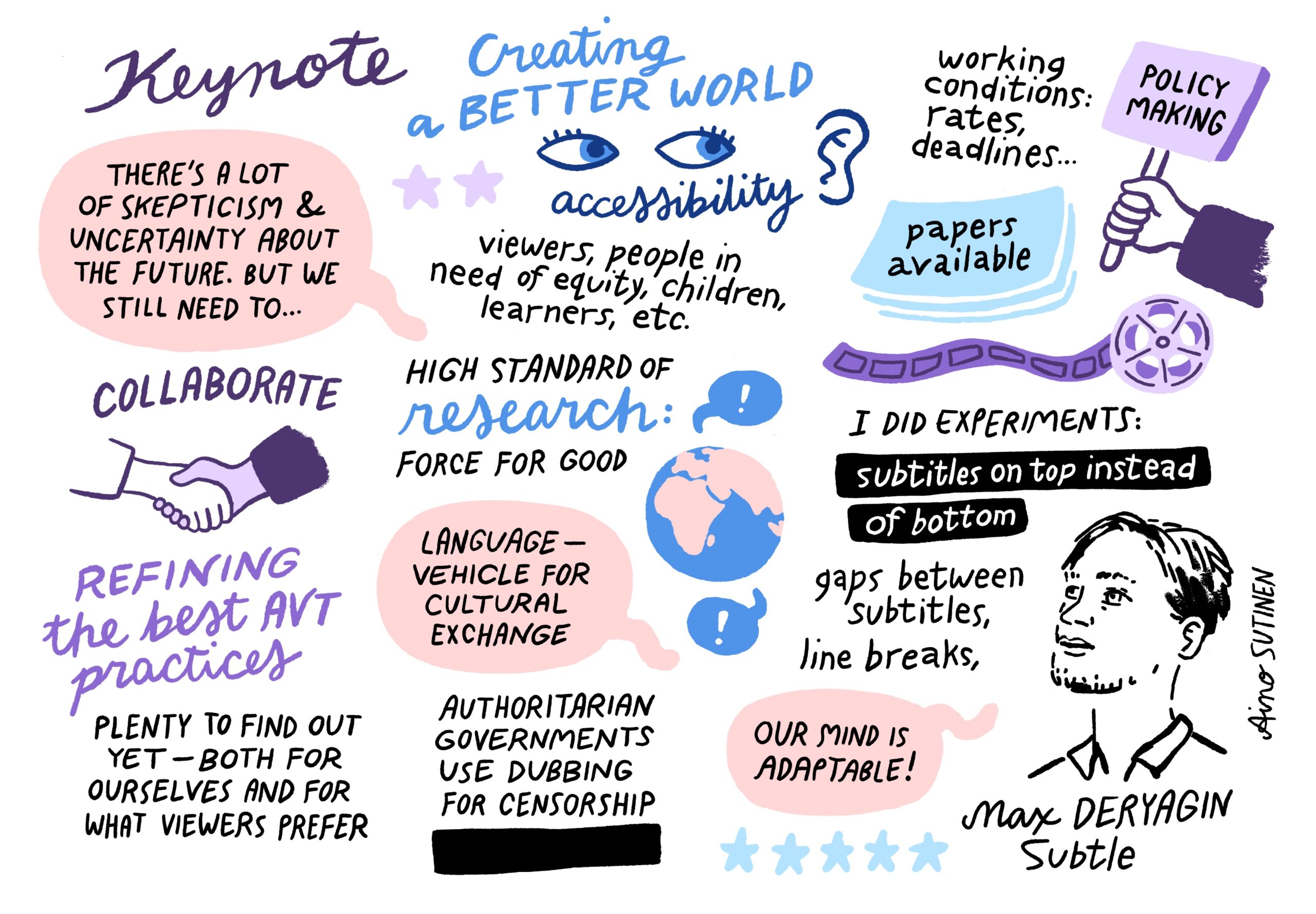
- I put all subtitles at the top of the screen instead of the traditional bottom, to see if that would hurt my viewer experience. At first, it was disorienting, as it wasn’t what I was used to. After a short while, however, it became rather fine and stopped bothering me whatsoever.
- Instead of having a consistent minimum gap between subtitles, which is supposed to create a certain visual rhythm for the viewer, I randomized it between two frames and six frames. Again, uncomfortable at first, but shortly after I got immersed in the story, and the randomness didn’t bother me at all.
- In a vertical short-form video, I gave font size small variance from one subtitle to another. That inconsistency didn’t irk me even slightly.
- I also experimented with various approaches to line breaks, segmentation, timing around shot changes, etc. — sometimes with surprising results.
These tests, however unscientific, helped me realize a couple of things. First, our mind is much more flexible and adaptable than we give it credit for, so it’s perhaps less about the precise numbers or specific characteristics we choose for our style guides and more about what our viewers are used to, their sense of familiarity. Second, we still have ways to go in terms of research — there’s certainly a lot to figure out, and figure out it we should, by sharing our professional intuitions with each other, organizing discussion forums, and being open to considering opposing views.
Reason #2: Ensuring a high standard of research

It might be difficult to accept for some, but not all studies are created equal — both generally and also in our particular field. Some of them might have a shaky methodology or non-sequitur conclusions, some can be somewhat biased due to corporate or political affiliations or personal beliefs, and others can be outdated but held as still relevant, in high regard, despite all the changes in technology and viewing habits we’ve witnessed in the past decades.
Indeed, research, when not held to the highest standard, can do harm to our trade, whether it be related to exaggerating machine translation’s effectiveness, to concluding that viewers don’t care so much about this or that, to purporting that translators are able to work faster thanks to some “technical innovations”, or that deaf viewers are fine with sterile, unemotive sound descriptions in SDH. But when done best, it can also be, and often is, a force for good.
- As far as the corporate world, academic research can shed light on our working conditions: rates, deadlines and mental health (like the paper on Working Conditions of Audiovisual Translators in Europe by Kristijan Nikolic et al.)
- In the world of content producers, it can affect budgeting, respect for our trade, understanding of it, our visibility, our rights and getting credited (Pablo Romero Fresco’s Accessible Filmmaking initiative is a shining example here)
- In policymaking: important policies can be introduced that ignore our needs or, conversely, support them based on research conclusions (Tiina Tuominen, Hannah Silvester, Jan Pedersen and a few other great researchers did excellent work in this direction).
It is upon us, then, to point out issues in studies and ring alarm bells when things don’t look right, but that can only be done if we make an active effort to read and understand the papers rather than just ignore them as practitioners — and as researchers, to strive to seek the truth rather than prestige or financial gain.
So, it is crucial for us to collaborate, to ensure unbiased, high-quality research rooted in reality, which for practitioners means filling out research surveys when needed, actively engaging with the academic community (which, I think, SubComm is an excellent initiative for) — and from the academic side, trying to make papers more findable, more discoverable, perhaps by organizing an openly accessible webpage with a filterable list of recent publications.
Reason #3: To create a better world
A lot in our profession, and indeed in the world, revolves around money and clout. But I’d like to remind everyone that there’s a higher purpose to it all. As everyone knows, language goes beyond simple communication — it’s a vehicle for cultural exchange, for education, for community building, for enablement, and for ensuring wellbeing of people. And AVT research, in some ways, shapes that very vehicle; through it, we learn how:
- To make sure people have a good time watching a movie or playing a video game, or visiting a museum or opera, without stressing over the issues with their texts or getting confused over what’s going on.
- To level the field for everyone in terms of access and equity: striving to create better SDH for deaf and HOH people, better audio descriptions for those blind and partially sighted, better plain language texts for those who need them — and thus contributing to the wellbeing of others, especially those traditionally marginalized.
- Through research, we learn how to improve learning itself: according to one study that I found out about from the Norwegian association of audiovisual translators NAViO, an average Norwegian reads 12 novels worth of text per year in just subtitles. That includes children, so the formation of their language skills, which affect one’s entire life, very much depend on the quality of the timed text they get to read. And we know that thanks to this one piece of research!
- Also thanks to research, we now know how oppressive governments can use — and historically have used — dubbing to censor, manipulate and distort audiovisual works to shift people’s opinions on certain issues. That kind of research, of course, is of immense importance, and if it wasn’t for Jorge Diaz Cintas’ publication on film censorship in Franco’s Spain, I wouldn’t have been introduced to it.
So, our job, and I mean both practitioners and academics, is more important than one might think. There’s quite a bit of responsibility here in ensuring a better future for everyone. And so, joining forces only makes sense, despite a lack of time and energy, and perhaps motivation.
So, let us collaborate.
Max Deryagin is an expert subtitler, consultant, conference speaker, independent researcher and writer, as well as chair of the International Association of Subtitlers SUBTLE, Vice President at the European Federation of Media Translators AVTE, and Talent Enablement Manager at subtitling company Plint. Throughout his career he has collaborated with translation agencies, production companies, broadcasters, software developers, universities, policymakers, activist organizations, fellow practitioners and other industry stakeholders. As an AVT activist, he works toward improving the working conditions of audiovisual translators, promotes the visibility, understanding and status of AVT, and helps cultivate good subtitling practices in Europe and beyond.
