
Overcoming Information Asymmetry
in the Subtitling Industry
I’m sure many subtitlers can relate: having to explain time and time again what it is exactly that they do. I can certainly remember times when I or colleagues found ourselves explaining the difference between the myriad types of subtitles we could provide to clients. Researchers like Callum Walker state that this kind of education is an inevitable part of our work (2023). It is a logical conclusion: if clients already knew how to subtitle, they wouldn’t be asking us to do it! But as I found certain questions coming up again and again, I started wondering whether there was a way to collaborate more efficiently and effectively. That led me to the three questions which underpin my research:
- What is the nature and extent of information asymmetry* in the subtitling industry?
- To what extent is it reasonable to expect stakeholders to be translation industry literate*?
- How do we ensure that stakeholders in the subtitling industry become and remain more industry literate?
*More on those terms soon!
The approach I’m taking places my research in what’s being called the translation industry turn in translation studies, with researchers studying the real world of translation and how the industry operates. More importantly, it also aims to bridge some of the divide between academia and industry (Massey, Ehrensberger-Dow and Angelone, 2024; Walker and Lambert, 2026), involving practitioners and other workflow stakeholders. My approach also borrows three key ideas from other disciplines: information asymmetry, translation industry literacy and change management.
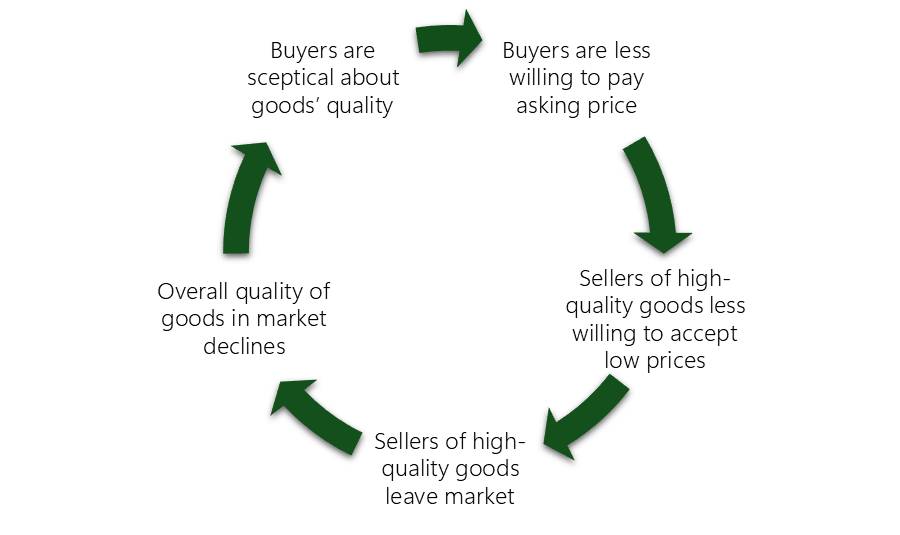
Information asymmetry is a concept taken from economics. Essentially, it refers to situations in which the seller of a good knows more about its quality than the buyer, like when buying a used car (Akerlof, 1970). As a result of the imbalance, the buyer is sceptical of the good’s quality and the seller’s true motives, becoming less willing to pay the asking price (ibid.). Andy Lung Jan Chan (2011) was the first to apply information asymmetry to translation and it certainly does resonate, including with subtitling. I can recall at least one project where I edited down the text in subtitles to comply with reading speed limits but got feedback from a client asking why they weren’t verbatim. Knowledge and expectations about best practice that I took for granted were not shared by the person I was working for and my work was questioned. Sound familiar?
Information asymmetry is not without its risks. Akerlof (1970) suggests it leads to adverse selection, a vicious cycle of decreasing prices pushing out good quality, eventually leading to market collapse. Multiple surveys in audiovisual translation studies already record concerns from subtitlers about working conditions and workflow practices, often claiming misunderstandings and lack of knowledge as being a key factor in their decline (Kuo, 2015; Nikolić et al., 2026; Oziemblewska & Szarkowska, 2022; Skwarek et al., 2024). In one survey, professionals are cited as considering whether to leave the market because of changing conditions (Künzli, 2022). One can only imagine the impact this would have on quality and the proclaimed “talent crunch” in the wider translation industry (Walker & Lambert, 2026).
So is there an alternative to information asymmetry? My own proposal is translation industry literacy, a concept inspired by Lynn Bowker’s machine translation (MT) literacy (2019). Bowker states that when individuals are more knowledgeable about how MT works and the potential risks and rewards— in other words, they are more MT-literate—they can use it more critically and effectively. Being translation industry literate would mean knowing about the industry, including translation processes and workflows, empowering stakeholders to be more critical and effective participants.
Translators and translator associations have already created many outreach projects to promote greater knowledge about their work. One example is Chris Durban’s guide to buying translations for the ITI (Durban, 2014). However, the real impact of these is hard to measure. Callum Walker suggests buyers’ guides have had little reach (2023).
Given such campaigns have struggled to create lasting impact, change management might be a useful tool. Change management, borrowed from business studies, considers how to embed lasting change in an organisation. Authors like Lauer (2020), Cameron (2014) and Hiatt (2012) point out that a change project can be planned and executed to perfection, logistics-wise at least, but that doesn’t guarantee that the change will be permanent and people won’t revert back to the old status quo. Change management models aim to respond to that dilemma, to ensure change goes smoothly and is more likely to be permanent.
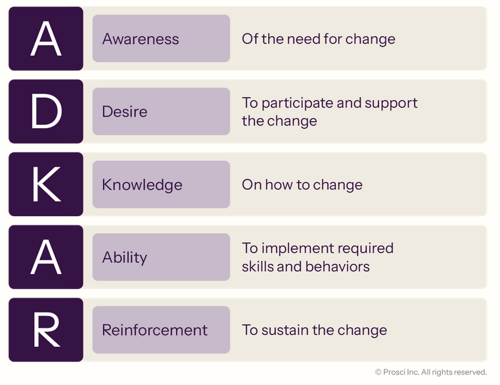
The ADKAR model by Hiatt (2006) is one such change management model, outlined in Figure 2. It’s a cumulative model, meaning that these five stages must come in order. Failure at any point has a knock-on effect on the success of the subsequent stages.
For my PhD, I aim to use the three key concepts I’ve just described as a framework for my data collection and analysis. My plan is to take stock of the situation in the subtitling industry by interviewing clients about their experience of buying subtitling services. So far, subtitling buyers are an underrepresented group in audiovisual translation research, when they are in fact a key member of the workflow. It’s the client who often determines rates, deadlines and guidelines for subtitlers and they are often the target demographic for the outreach attempts I mentioned above. What’s more, from a change management perspective, it’s important to build a picture of what is currently happening before attempting to move from one status quo to another (Cameron & Green, 2014) and get everyone on the same page, setting everyone up for success. I will be undertaking interviews with a range of people who have bought subtitling services to gather their thoughts about how they view subtitling and their perspectives on industry knowledge.

The next stage in my research is recruiting participants. If you are someone who buys or has ever bought subtitling services, or you have contacts who fit the bill, I’d love to hear from you! The interviews will take place online using Zoom at a time convenient to you. All data collected will be handled in complete confidentiality in line with research ethics guidelines. By taking part, you get to contribute to an innovative and emerging area of translation studies, as well as aiding more efficient and frictionless collaboration in the subtitling industry. If you’re interested or have any questions about my research or the interviews, don’t hesitate to get in touch. Also, please consider sharing this call for participants among your network to anyone who may be interested.
Bibliography
Akerlof, G. A. (1970). The Market for ‘Lemons’: Quality Uncertainty and the Market Mechanism. The Quarterly Journal of Economics, 84(3), 488–500. https://doi.org/10.2307/1879431
Bowker, L. (2019). Machine Translation Literacy as a Social Responsibility. Language Technologies for All (LT4All). [open access]
Cameron, E., & Green, M. (2014). Making sense of change management: A complete guide to the models, tools and techniques of organizational change (3rd ed.). Kogan Page.
Chan, A. L. J. (2011). Information economics and the translation profession: An empirical investigation into translator certification and other signaling mechanisms in the translation marketplace. LAP Lambert Academic Publishing. [PhD on which book is based open access]
Künzli, A. (2022). How subtitling professionals perceive changes in working conditions: An interview study in German-speaking countries. Translation and Interpreting Studies, 18(1), 91–112. https://doi.org/10.1075/tis.20107.kun
Kuo, A. S.-Y. (2015). Professional Realities of the Subtitling Industry: The Subtitlers’ Perspective. In R. B. Piñero & J. D. Cintas (Eds), Audiovisual Translation in a Global Context (pp. 163–191). Palgrave Macmillan UK. https://doi.org/10.1057/9781137552891_10
Nikolić, K., Tonković, M., & Díaz Cintas, J. (2026). Working Conditions of Audiovisual Translators in Europe. Parallèles, 38(2), 1–25. https://doi.org/10.17462/para.2026.02.02 [open access]
Oziemblewska, M., & Szarkowska, A. (2022). The quality of templates in subtitling. A survey on current market practices and changing subtitler competences. Perspectives, 30(3), 432–453. https://doi.org/10.1080/0907676X.2020.1791919 [open access]
Skwarek, A., Szarkowska, A., & Szkriba, S. (2024). Are Templates Killing the Subtitling Principles? Subtitlers’ Views on the Impact of Templates on the Media Localisation Industry. Journal of Audiovisual Translation, 7(2), 1–20. https://doi.org/10.47476/jat.v7i2.2024.288 [open access]
Walker, C. (2023). Translation project management. Routledge.
Walker, C., & Lambert, J. (2026). What’s in a Name? Mapping the Translation Industry. In J. Lambert & C. Walker (Eds), The Routledge Handbook of the Translation Industry. Routledge.
Ceri Pollard is a PhD student at the Faculty of Translation and Interpreting at the University of Geneva, Switzerland. She holds an MA in Translation and Specialised Multilingual Communication also from the University of Geneva and a BA in Translation, Media and French from the University of East Anglia. Her BA and MA dissertations were both on the topic of creative subtitling. She also worked for several years as a professional subtitler, working in-house at a UK-based LSP. Her research interests include the subtitling industry, creative subtitles and audience reception/cognitive processing studies.
