
Subtitling for NETFLIX:
How subtitlers experience it
and what they wish for the future
By Tinka Stössel
How much do we really know about what it’s like to subtitle for Netflix? With its global, competitive, and highly technological nature, subtitling for streaming is subject to frequent changes and the system remains rather mysterious from the outside. But what about for subtitlers? Are they also confused? What would they like to see improved?
Coming from a non-AVT (audiovisual translation) background, I am using my PhD project to better understand what is going on in interlingual subtitling for streaming and how subtitlers experience the current system. Previous research has often included multiple types of AVT, employment scenarios, companies, or languages. In my research, I thus wanted to investigate one company and one target language to better pinpoint issues and find possible solutions that can potentially be applied more widely. As this research is still ongoing, I want to point out that I am only sharing a very condensed sneak peek here and that the data is subject to change before I submit my final dissertation later this year. If you want to read the behind-the-scenes director’s cut extended version, the corresponding book to my research should be available sometime next year.
So, let’s dive in! Taking an explorative research approach, I wanted to try and learn as much as I can about the subtitling system and subtitlers’ experiences. To do this, I first decided to harness the power of social media and joined three Facebook groups that focused mainly on interlingual subtitling for streaming.
Within these groups, I collected and analyzed 6 years’ worth of subtitlers’ experiences, totaling 1789 posts and their corresponding comments. While these were not only concerned with Netflix, they helped me to understand how everything works, such as that all major streaming companies outsource their projects to mostly the same LSPs (Language Service Providers). This means that many experiences are likely shared among subtitlers for the different companies. I also learned about the main issues that subtitlers are facing. By far the main issue is low rates, followed by communication issues with LSPs, an insufficient workload, and a lack of transparency in the subtitling system.
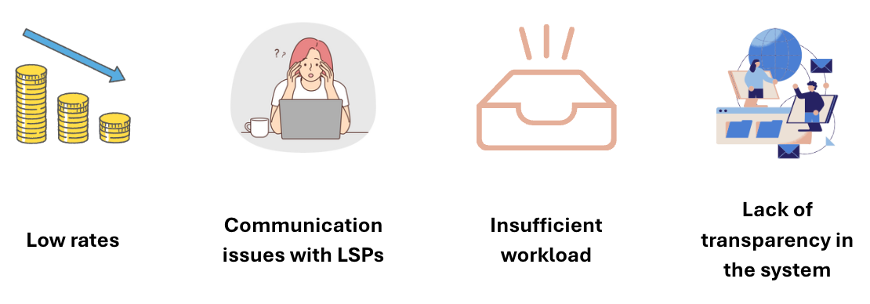
While these are the main concerns for all companies, I wanted to find out if these were the same for Netflix. Looking more closely at the time after the COVID-19 pandemic, I sorted out 144 posts specifically mentioning Netflix and found that among these, the main concern changed from low rates to system transparency:
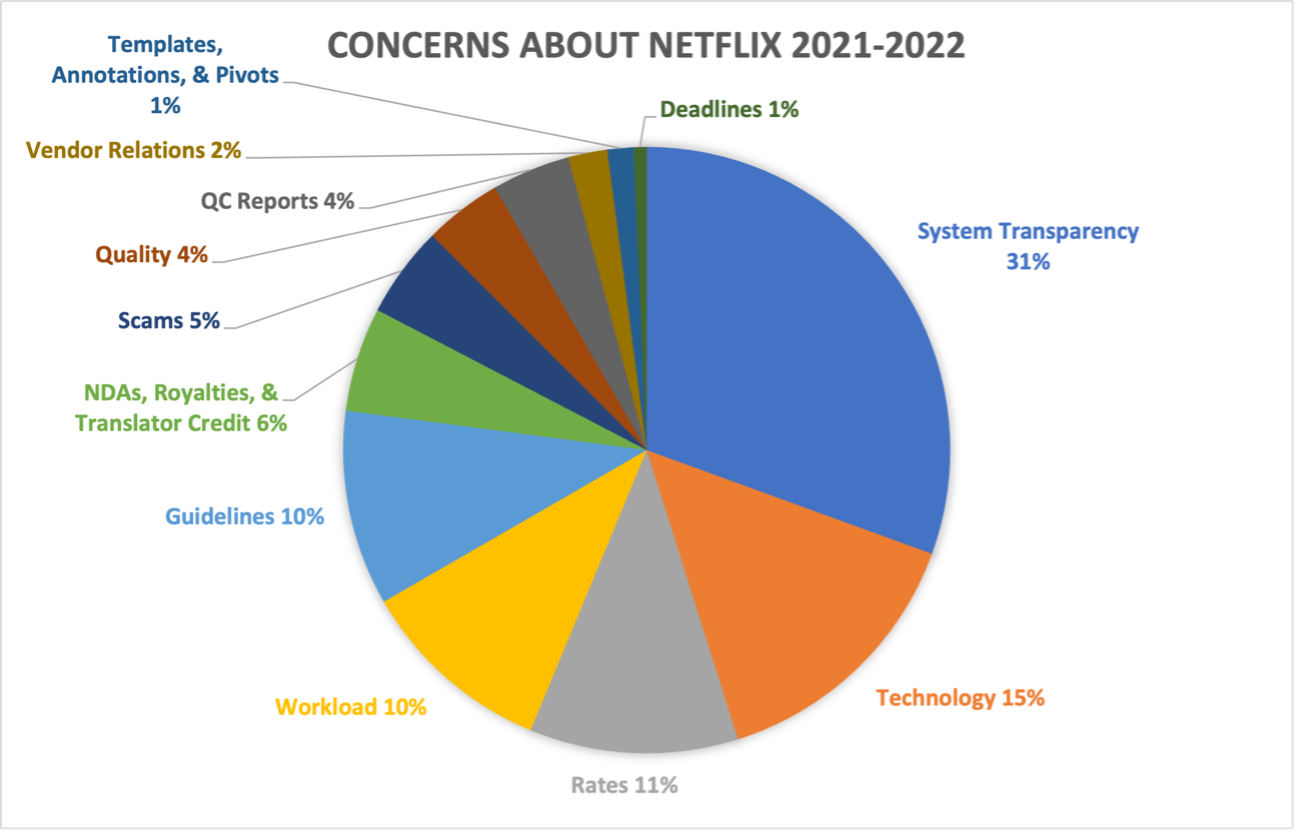
Interesting here is that rates dropped down to 11% of posts while communication (shown here as Vendor Relations) fell all the way down to 2%. Since many posts did not indicate the end client, however, this can be misleading, and it is possible that many more posts referred to Netflix projects. We thus cannot conclude from this data that rates or communication are better when working for Netflix, but it shows that subtitlers experience most of the same issues with Netflix as with other companies.
To further narrow down the pool of information and ask more specific questions, I decided to continue with a survey focused on Netflix and German as the target language to gain some deeper insight. Here, I specifically chose a survey because the Facebook data suggested that non-disclosure agreements sometimes forbid subtitlers from revealing Netflix as their end client. This made it impossible for me to conduct interviews, so a survey was the best way for me to gather information anonymously while still giving subtitlers enough room to share their experiences by means of free response comment boxes throughout the questionnaire.
Looking at the main issue of system transparency, I took the main points reported in the Facebook study and asked what subtitlers understood about their job:
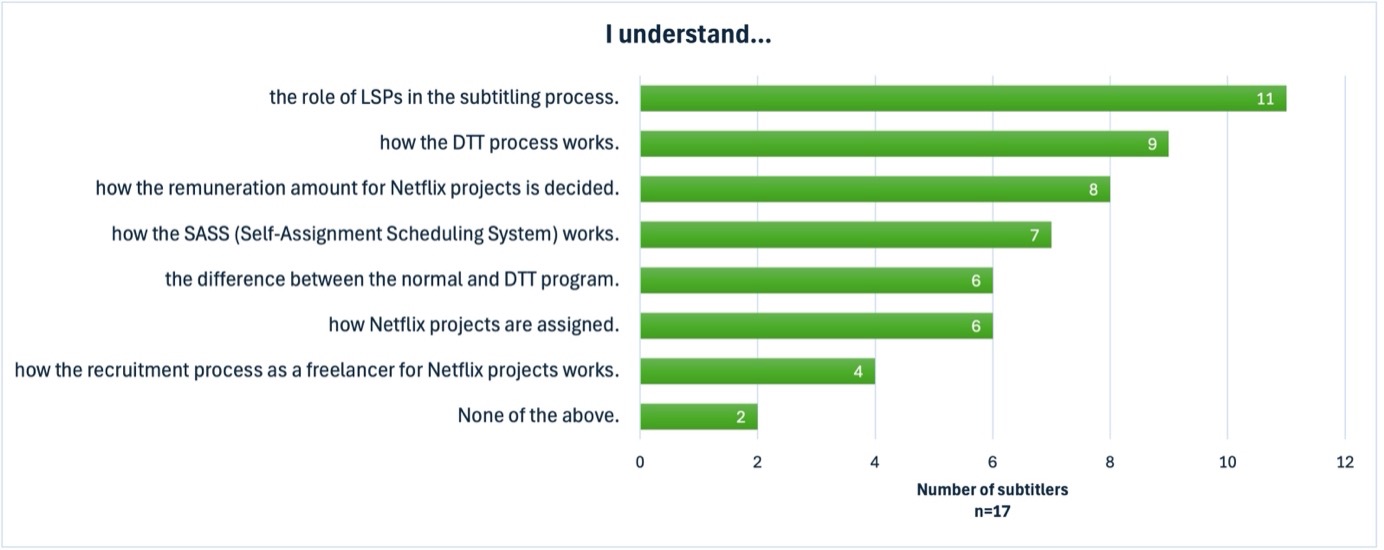
Of the 17 respondents to this question, we can see that only the role of the LSPs is relatively well understood. To better understand some of the other answer choices, it is important to note that Netflix uses different production pathways depending on the type of content. Regular licensed content follows what is indicated here as the “normal” process, while high-profile and Original content follow the Direct-Timed-Text pathway. Based on the Facebook study, there are several differences between the pathways including that DTT projects are more strictly controlled and only available to certain LSPs. They are subtitled in Netflix’s own subtitling software Originator, are self-assigned through the SASS system where subtitlers can choose projects themselves, and are subject to a strict quality metrics system. For normal projects, LSPs have more freedom in these matters, but it seems that things are not harmonized across or even within LSPs for either process.
The fact that this could provide an additional source of confusion is confirmed in the results above: Just over half of survey respondents understand the DTT process and just over a third were clear on the difference between the two pathways. Beyond that, all other aspects also remain unclear for the majority of subtitlers. Two admitted that they understood none of them, and one specifically addressed the transparency issue in their comment:
“There is no transparency in how projects are assigned.
That is really what annoys me the most.”
Another said that they would like “more information about what happens behind-the-scenes.” To thus answer one of my initial questions, it is not just the outsider looking in who is confused. Many subtitlers are also in the dark about certain aspects of Netflix’s subtitling system.
Looking into some other issues, I asked subtitlers what they would tell Netflix if they could speak to the company directly. Here, again, we see significant overlaps with the Facebook data:
- Quality control is an important step that should always be carried out since “every translator makes typos.”
- There should be the option to use your own software, and Netflix’s own Originator software should be improved.
- Unfriendly and unclear communication should be fixed.
- Guidelines should be user-oriented instead of catering to “what is easiest for subtitlers, PMs [project managers] and the software.”
- The working conditions should be more “family-friendly.”
While the survey sample is small, many of the issues from the wider Facebook study are also represented here. This confirms that working on Netflix projects is not so different from working on projects for other streaming companies and that many of the same improvement suggestions could be applied more widely. But what exactly could the future look like?
I have a dream…
In one of my final questions, I asked subtitlers to dream a little bit and tell me what they would wish for in the future based on suggestions I found mostly in the Facebook data:
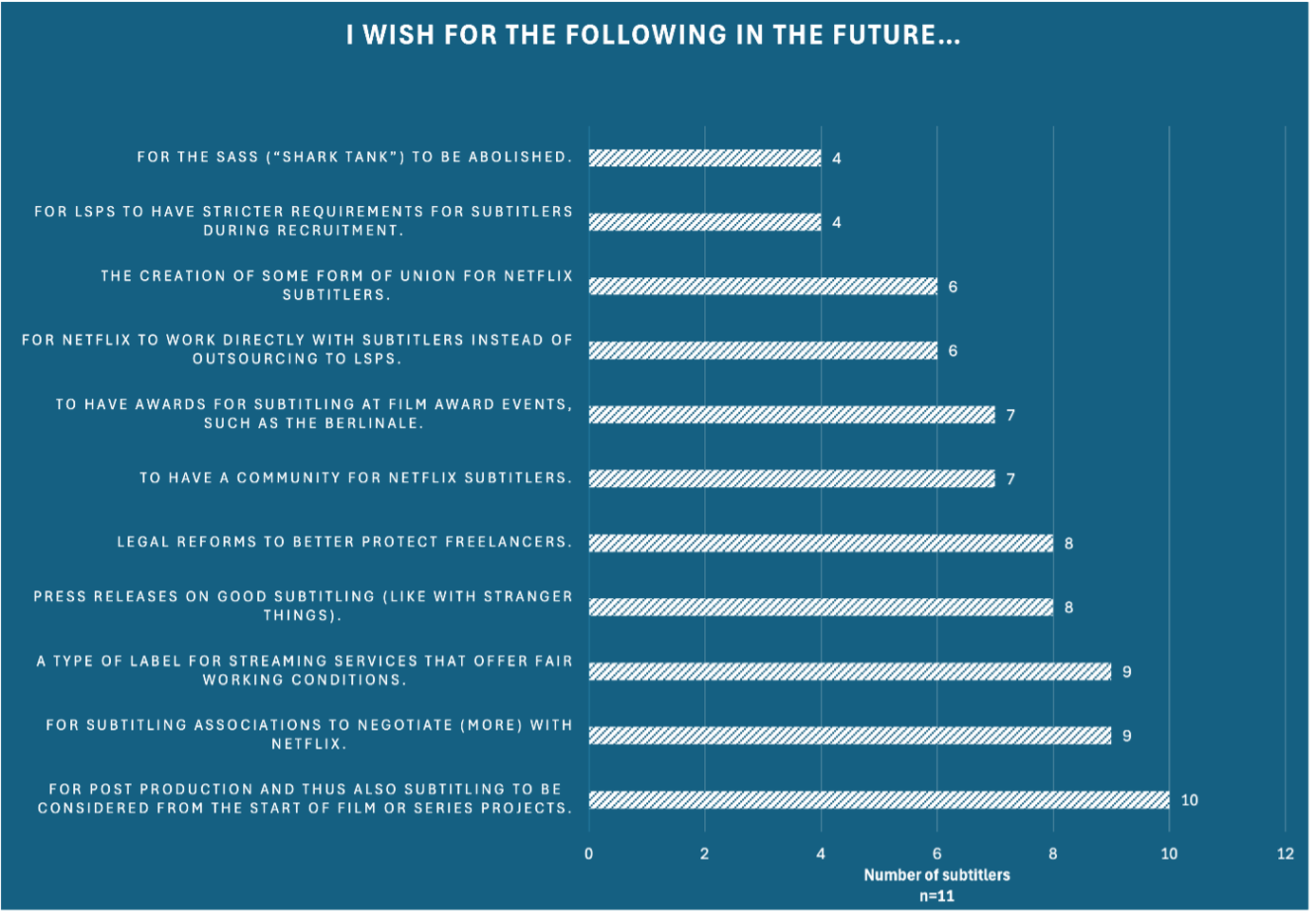
This list is by no means exhaustive, but it helps to understand the priorities of subtitlers and start working towards making them a reality. I will be further exploring these and other topics on how to improve the subtitling system in my dissertation, but I hope this behind-the-scenes sneak peek has helped open up the world of subtitling for streaming from the subtitlers’ perspective.
If you are a practitioner and want to share your own experience, feel free to leave a comment! Do you experience similar issues in subtitling for Netflix or with the subtitling system more generally? What would you like to see in the future?
Want to learn more about the subtitlers’ perspective? Check out these related research articles:
Caseres, S. (2024). Practitioner perspectives in the French subtitling industry: Insights into collaborative work practices. Parallèles, 36(2), 71-85. DOI: 10.17462/para.2024.02.05 (Open access)
Künzli, A. (2025). Subtitle quality in the streaming era—The subtitling professional’s perspective. Applied Linguistics. 46(5), 744-757. https://doi.org/10.1093/applin/amae064 (Open access)
Nikolić, K. et al. (2026). Working conditions of audiovisual translators in Europe. Parallèles, 38(2). DOI: 10.17462/para.2026.02.02 (Open access)
Stössel, T. (2026). What can Facebook tell us about subtitlers’ concerns regarding automation? In A. Montes-Sánchez & C. Rodríguez-Faneca (Eds.), Lengua, ciencia y traducción en la era de la inteligencia articifial (pp. 465-480). Tirant humanidades. (Available on Researchgate)
I have been a fan of Netflix since the early 2000s when my family received its first red envelope in the mail. Being a long-time customer, I watched the company grow from a DVDs-by-mail service into the global streaming empire we know today. As a language enthusiast with a background in linguistics, I made it the mission of my PhD to learn more about how the company handles language and translation. Now in Switzerland at the University of Geneva, I also teach practical subtitling workshops and work as an editorial assistant for the translation studies journal Parallèles. Feel free to follow me on LinkedIn or Researchgate!
