

Between Objectivity and Fear:
Audio Description in Spanish Horror Films
By María López Rubio
Spanish horror films by directors such as Álex de la Iglesia and Paco Plaza use visual and auditory tension to create fear. For audio describers, this creates an important challenge: how to convey what happens on screen for blind and visually-impaired spectators while preserving the intended suspense (López Rubio, 2024).
Most guidelines recommend being objective (Torre López, 2023), describing only what appears on screen. However, only describing the facts could possibly reduce the emotional impact of horror (López Rubio, 2024). Based on an analysis of six recent Spanish horror films, the study suggested a 60/40 balance, that is, audio descriptions were approximately 60% objective and 40% subjective, which contributed to conveying tension and fear (López Rubio, 2024).
The challenge in horror

Horror depends on visual and auditory elements that produce emotions among the audience. Standards such as Spain’s UNE 153020 (AENOR, 2005) recommend neutral language, such as in the following examples, taken from the corpus for this study, and translated into English (see López Rubio, 2024): “a shadow moves across the wall” rather than “a threatening shadow creeps closer”.
While neutral language is accurate, it can leave the audience informed but not emotionally engaged. Research shows that including limited subjectivity can strengthen audience response and that naming emotions helps the audience feel more involved (see, for example, Ramos Caro & Chica, 2013, and Stefanini & Matamala, 2015). As shown in previous studies (see Romero Muñoz, 2023), professional audio descriptions often combine objectivity and subjectivity to match the purpose or skopos (Reiss & Vermeer, 1984) of the film—which, in the case of horror, is usually to create a sense of fear.
Findings from real scripts
In the study I conducted (López Rubio, 2024), 166 audio description segments from six Spanish horror films (2020–2023) were analysed, totalling over 3,000 words, with 22–35 segments per film.
Here are some of the main findings, including examples taken from the corpus, which have been translated into English from Spanish.
Key results:
- Subjectivity ranged from 11% to 67% depending on the film, with an average balance of 40.4% subjectivity / 59.6% objectivity.
- This suggests that professional describers naturally balance accessibility and emotional impact.
- Subjective elements (approx. 40%) include:
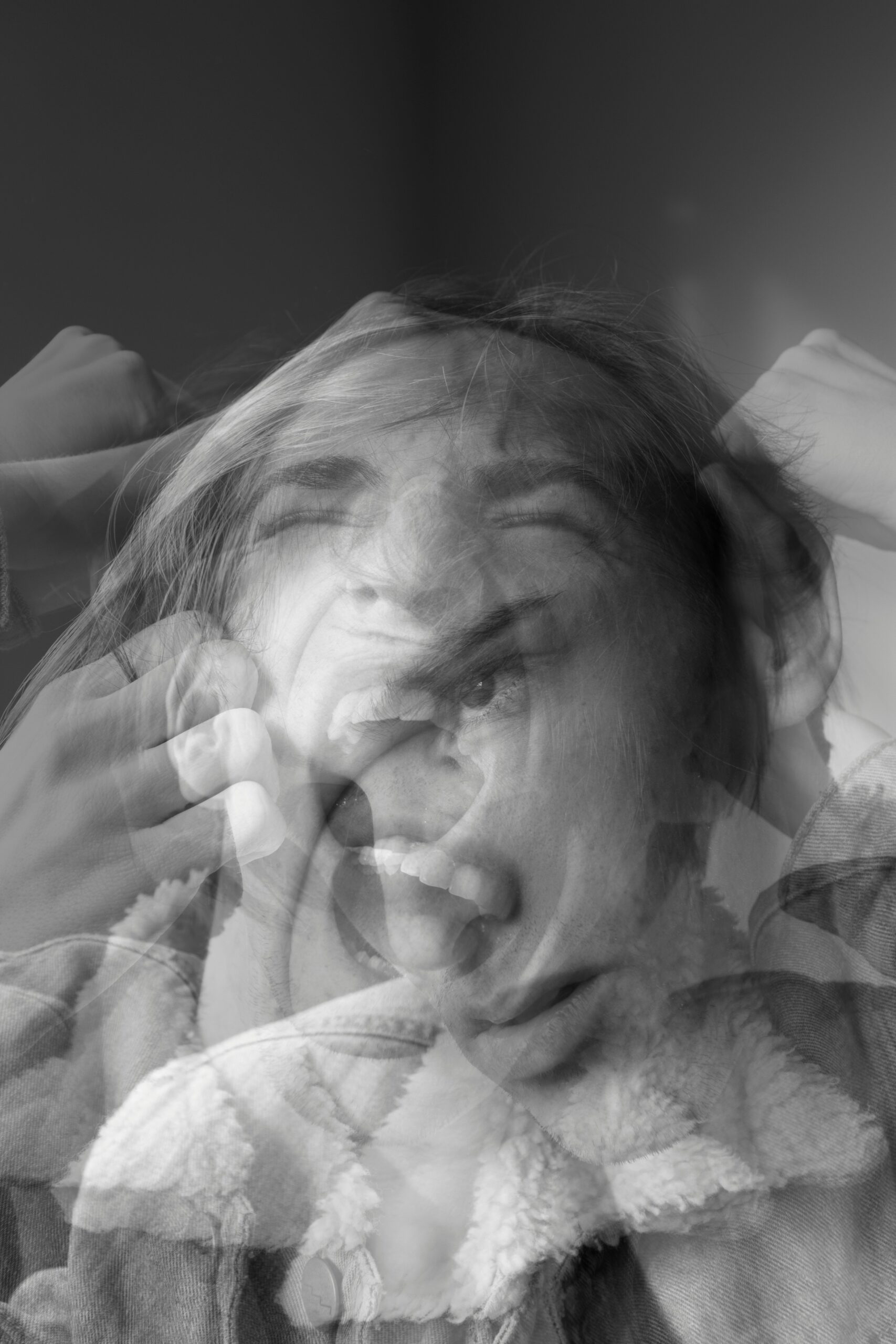
Credit: Callum Skelton, Unsplash - Naming emotions (“terror in her eyes”)
- Evaluative language (“sinister shadows,” “aged hands”)
- Interpretative additions (“something lurks unseen”)
- Occasional metaphors (“blood pools like ink”)
- Objective elements (approx. 60%) still create tension through:
- Precise physical details (“a red stain spreads on the floor”)
- Careful pacing and pauses
- Strategic silences
- Neutral, low-pitched voice delivery
Together, these elements help the audience understand the story while experiencing its intended emotions.
Practical guidance
Further research is needed in order to consider the replicability of these findings. However, the 60/40 framework may be a useful starting point for practitioners. The results obtained (López Rubio, 2024) suggest that it is helpful to begin with objective description to ensure clarity, particularly in complex or fast-moving scenes, and to add subjective details when needed to suggest emotion, build suspense, or highlight important moments. This approach is consistent with research such as that of Romero Muñoz (2023), which indicates that objectivity and subjectivity work together as complementary features in audio description scripts.
The table below shows the strategies found in the corpus. It illustrates the correlation between objective and subjective examples and the possible effects that the coexistence of objective and subjective elements may have on the audience, which should be confirmed through further reception studies.
| Strategy | Objective example | Subjective example | Possible effect[1] |
| Emotions | “Sweat is visible on the forehead” | “She appears terrified” | This combination may enhance empathy and tension |
| Atmosphere | “The shadow changes position” | “The shadow appears threatening” | This combination may increase suspense |
| Rhythm | Pause after a sound | “It [the shadow] moves gradually” | This combination may help maintain suspense |
| Voice | Even, low tone | Slight rise for urgency | This combination may enhance engagement |
[1] These effects still need to be confirmed through reception studies.
Possible recommendations for practitioners:

- Describe the important visual information first
- Use subjective language only when the images clearly support it
- Use silence strategically: not describing every moment can heighten tension
- Use voice and pacing carefully
- Help keep the emotional effect of the scene
Future directions
Further studies could explore questions such as these:
- Do blind audiences report stronger emotional responses with moderate subjectivity?
- Can physiological measures (e.g., heart rate) provide objective data on fear response?
- How does this balance change in other genres, such as comedy or drama?
- Could AI tools personalise description according to audience preferences?
Conclusion
The analysed corpus shows that effective audio description for horror balances clarity and emotional impact. Objective details ensure accessibility, while carefully chosen subjective details communicate suspense and fear. The 60/40 framework can be a useful starting point for audio describers who want to keep both accuracy and the emotional effect of horror (López Rubio, 2024).
References
AENOR. (2005). UNE 153020: Audiodescripción para personas con discapacidad visual. Requisitos para la audiodescripción y elaboración de audioguías. Asociación Española de Normalización y Certificación.
López Rubio, M. (2024). Una aproximación a la audiodescripción del terror para personas con discapacidad visual: Estudio de un corpus de películas españolas de terror. Parallèles, 36(2). https://doi.org/10.17462/PARA.2024.02.03 [open access].
Ramos Caro, M., & Chica, N. (2013). El impacto emocional de la audiodescripción. Universidad de Las Palmas de Gran Canaria. http://sid.usal.es/idocs/F8/FDO26498/emociones_audiodescripcion.pdf [open access].
Reiss, K., & Vermeer, H. J. (1984). Groundwork for a general theory of translation. Niemeyer.
Romero Muñoz, A. (2023). Multimodal analysis as a way to operationalise objectivity in audio description: A corpus-based study of Spanish series on Netflix. Journal of Audiovisual Translation, 6(2), 8–32. https://doi.org/10.47476/jat.v6i2.2023.251 [open access].
Stefanini, I., & Matamala, A. (2015). The emotional impact of language in audio description. Perspectives: Studies in Translation Theory and Practice, 23(4), 634–650. https://doi.org/10.1080/0907676X.2015.1120760 [open access].
Torre López, A. (2023). Audio Description Guidelines: UNE 153020 Standard and Netflix Style Guide. Professional Communication and Translation Studies, 16. https://www.sc.upt.ro/attachments/article/766/03_01_Lopez.pdf [open access].
Dr María López Rubio is a researcher in audiovisual translation and accessibility and she currently teaches at the Universitat de València and Universitat Jaume I. She holds a PhD with International Mention and Cum Laude honours, specializing in audio description of humour. She was awarded the National Award for Excellence in Academic Performance and the Extraordinary Degree Award for her outstanding record, as well as the sole prize in the PhD Thesis category at the IV IQH Research Awards.